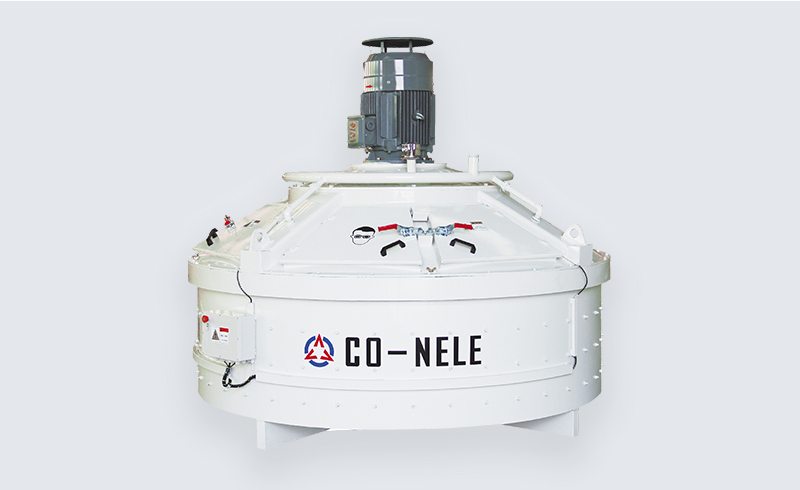
co-nele intensive mixer

How to Select a Planetary Concrete Mixer with the Right Capacity (CO-NELE Recommendation)

2026.3.27  |  CO-NELE

Step 1: Define Your Core Production Goals

Start by clarifying your production scale, batch frequency, and project timeline—this forms the foundation of capacity selection.

Key Questions to Answer:

  1. What is your target daily/weekly/monthly output?
    • Small projects (residential construction, small precast workshops): 10–50 m³/day
    • Medium projects (commercial buildings, medium precast plants): 50–200 m³/day
    • Large projects (high-rise construction, industrial precast factories): 200+ m³/day
  2. What is the production cycle (mixing + discharge + cleaning) of the mixer?

    Planetary mixers typically have a total cycle time of 2–4 minutes (mixing: 20–40s, discharge: 10–30s, cleaning: 30–60s). This is a critical variable for calculating output.
  3. Are you operating single-shift, double-shift, or 24/7?
    • Single shift (8hrs): Lower output target
    • Double shift (16hrs): Double the daily output target
    • Continuous operation: Maximize hourly output

Selection of Planetary Concrete Mixer Capacity

Step 2: Calculate the Required Mixer Capacity (Formula-Based)

Use this formula to compute the minimum required rated capacity of the planetary mixer, accounting for cycle time and production goals:

Formula for Rated Capacity (RC)

RC = Target Hourly Output (m³) / Number of Batches per Hour

Where:

  • Number of batches per hour = 60 minutes / Total cycle time (minutes)
  • Target hourly output = Daily target output (m³) / Operating hours per day

Example Calculation

Suppose you need 100 m³/day with a 10-hour operating shift and a mixer cycle time of 3 minutes (0.05 hours):

  1. Hourly output = 100 m³ / 10 hrs = 10 m³/h
  2. Batches per hour = 60 mins / 3 mins = 20 batches/h
  3. Required rated capacity = 10 m³/h / 20 batches/h = 0.5 m³ = 500L

Note: Always round up to the next standard capacity (e.g., 750L instead of 500L) to account for minor delays (material loading, equipment checks).
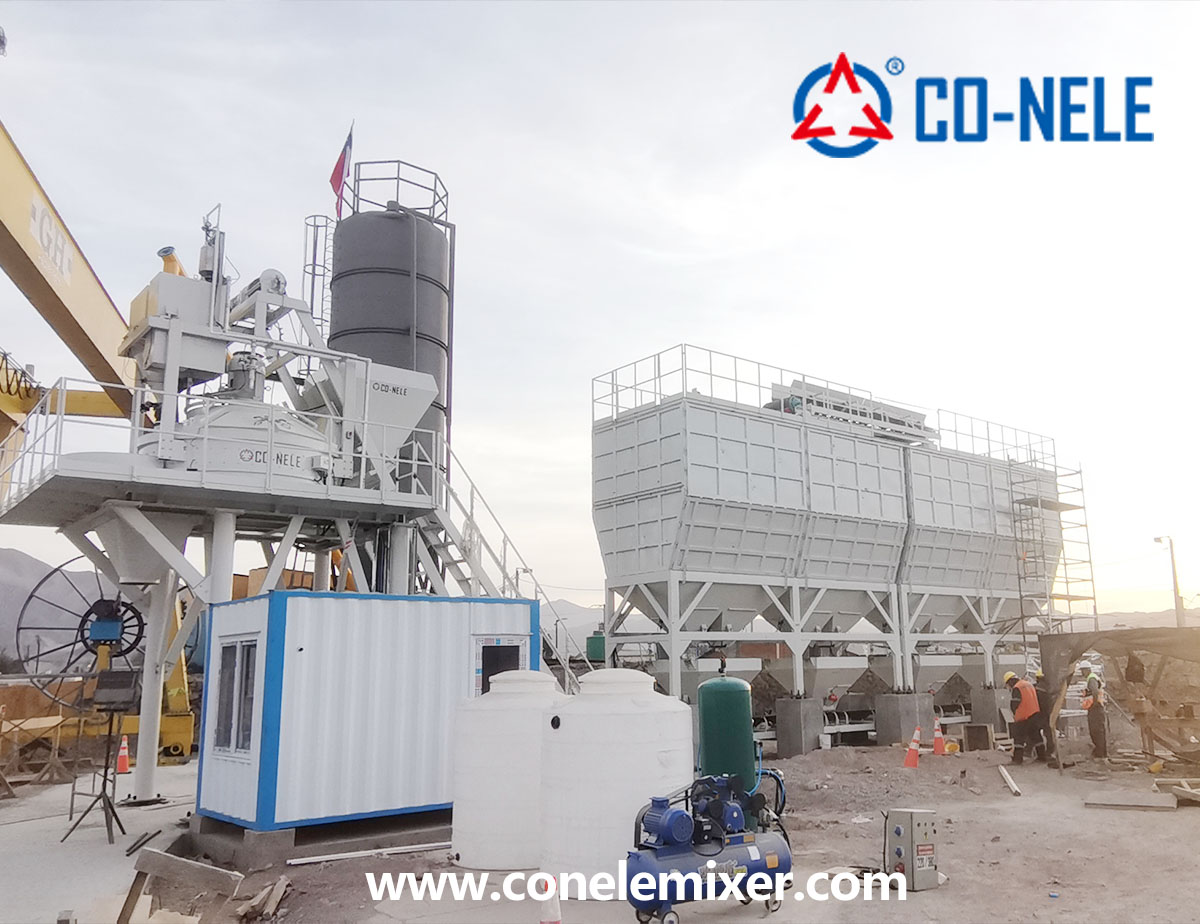
Selection of Planetary Concrete Mixer Capacity

Step 3: Account for Mixer Rated vs. Effective Capacity

Planetary concrete mixers have two key capacity metrics—rated capacity (RC) and effective working capacity (EWC):

  • Rated Capacity: The theoretical maximum batch volume (marked on the mixer, e.g., 750L, 1500L).
  • Effective Working Capacity: The actual usable volume (typically 70–85% of RC) to ensure uniform mixing (overfilling causes poor homogeneity and equipment damage).

Critical Rule: Never use 100% of the rated capacity for production. For example, a 1000L rated mixer has an effective capacity of ~700–850L.

Step 4: Match Capacity to Material & Application

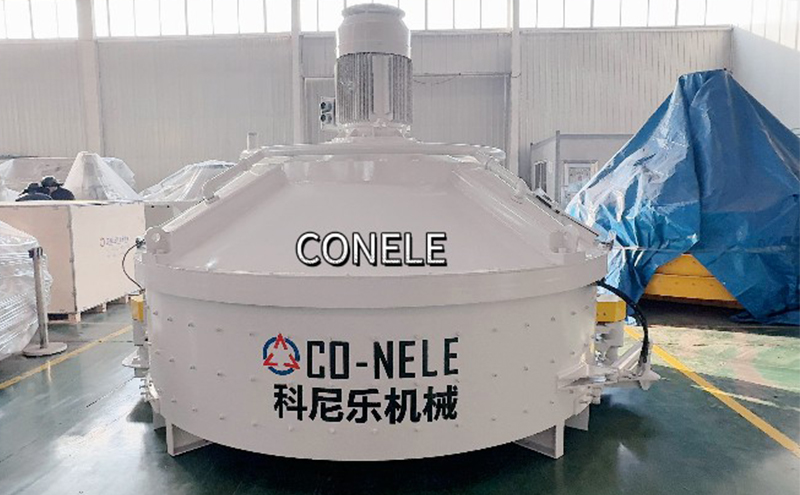
Different concrete types and applications require different capacity ranges—avoid one-size-fits-all selection. CO-NELE offers a full range of CMP series planetary mixers (CMP50 to CMP6000) to cover all scenarios:

Application/Concrete TypeRecommended Capacity RangeCO-NELE Matching ModelRationale
Small construction sites, lab testing50–500LCMP50–CMP500Low batch volume, precise mixing for small tests
General concrete (C10–C60), small precast500–1500LCMP750–CMP1500Balances efficiency and cost for small-to-medium batches
High-performance concrete (HPC/UHPC), fiber-reinforced concrete1500–5000LCMP2000–CMP5000Requires larger effective capacity for uniform dispersion of additives
Large precast factories, commercial concrete plants3000L+CMP3000–CMP6000High-volume continuous production
Refractory materials, dry mortar500–2000LCMP1000–CMP2000Small batches for specialized material mixing

Step 5: Factor in Site & Operational Constraints

  1. Power Supply Limitations: Larger capacity mixers require higher motor power (e.g., 55kW for 1500L, 110kW+ for 3000L). CO-NELE's mixers are equipped with self-developed high-torque reducers for efficient power transmission, ensuring compatibility with standard industrial power systems.
  2. Space Availability: Oversized mixers take up more floor space—critical for small precast workshops or confined construction sites. CO-NELE offers compact designs for space-constrained sites and customizable layouts.
  3. Material Handling: Match mixer capacity to your batching hopper, conveyor, and discharge equipment. A 3000L mixer requires larger upstream/downstream equipment to avoid bottlenecks. CO-NELE provides complete production line solutions, including matching batching, conveying, and control systems.
  4. Future Scalability: If your production volume is expected to grow (e.g., expanding precast capacity), choose a mixer with a slightly larger capacity than your current needs to avoid immediate replacement. CO-NELE's modular design allows for upgrades and expansions.

Step 6: Avoid Common Capacity Selection Mistakes

  1. Overbuying: An oversized mixer wastes energy and money for small batches (e.g., a 3000L mixer for 50 m³/day production).
  2. Underbuying: An undersized mixer causes constant bottlenecks, delays, and reduced mixing quality.
  3. Ignoring Effective Capacity: Forgetting that effective capacity is lower than rated capacity leads to inaccurate production calculations.
  4. Not Accounting for Cycle Time: Overestimating batch frequency without accounting for cleaning, loading, or discharge delays.

Quick Capacity Selection Checklist

  1. Calculate your target hourly output and batches per hour.
  2. Compute the minimum rated capacity using the formula.
  3. Round up to the nearest standard capacity.
  4. Verify effective capacity (70–85% of rated) matches your batch needs.
  5. Match capacity to your concrete type and application (refer to CO-NELE's CMP series models).
  6. Check power, space, and scalability constraints.
  7. Consult CO-NELE's technical team for customized recommendations.

Final Tip

CO-NELE is a leading manufacturer of planetary concrete mixers with over 20 years of experience, CE certification, and more than 100 national patents. Their CMP series offers a full range of capacities, high mixing uniformity, and reliable performance for various applications. Always consult the manufacturer's technical specifications and production experts. Reputable suppliers like CO-NELE can provide customized capacity recommendations based on your unique production workflow, ensuring optimal performance and cost efficiency.

By following this structured approach, you can select a planetary concrete mixer with the exact capacity needed to meet your production goals while avoiding inefficiencies and unnecessary costs.
Back To The List  

Related News

2026.3.19

Ceramic Mixture Granulator - Intensive Mixer Based Professional Equipment

CO-NELE ceramic mixture granulator, taking intensive mixer as core, has obvious advantages over traditional granulation equipment: higher mixing uniformity, better granule sphericity, more stable particle size control, higher efficiency and lower energy c

2026.3.5

CO-NELE Intensive Mixer Technical Principles and Full Types Selection Guide

Whether you're exploring cutting-edge materials research or optimizing processes for large-scale production, CONELE intensive mixers offer complete solutions from principles to equipment, from the lab to the factory.

2026.2.26

6-Minute Rapid Granulation - CR02 Laboratory Granulator Helps Korean Client Achieve Great Success in Magnesium Hydroxide Experiment

Relying on the CO-NELE CR02 laboratory intensive mixing granulator (5 liters effective volume), through three batches of experiments, our technical team successfully granulated the raw material into uniform spherical particles with a particle size of 2-3

Related Products

conele concrete mixer

After Sales Contact

The Pioneer Of China's Concrete Mixer
Equipment.

E-mail:mixer@co-nele.com
conele concrete mixer

After Sales Support

Our after-sales service is at your disposal for all
questions

Tel:0086-15253277366
conele concrete mixer

CO-NELE

Houguzhencun Xiazhuangjiedao Chengyang Dist
Qingdao City China

Show on the Map

GET YOUR FREE QUOTE

We will contact you within 24 hours.

X